Benchmark |
|

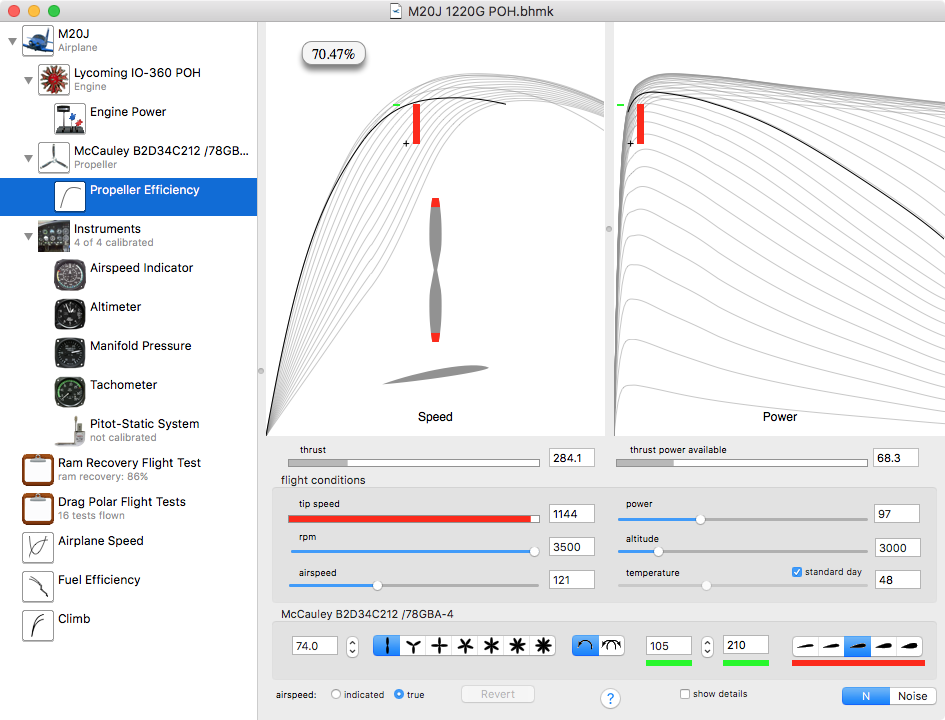
Propeller Efficiency Calculator Now, with the propeller, you can use the Propeller Efficiency Calculator. You have sliders that you can move to change the settings, or you may type the numbers. This uses the Boeing General Propeller Chart as the basic for all of the calculations. The green bar in the chart is the loss or gain in propeller efficiency due to the total activity factor. Typically, this is a very small amount. |

If you use excessive rpms, the tip speed will go supersonic and the loss in efficiency for the tip speed is shown in a red bar and the blade thickness then becomes a relevant factor. |
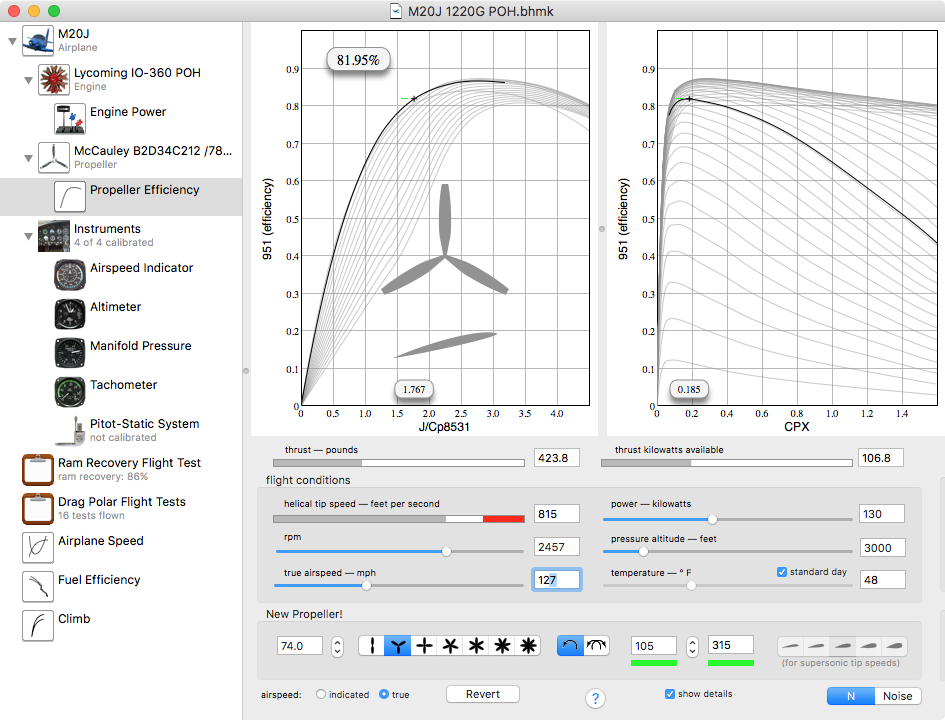
We have made every effort to present a simplified view of propeller efficiency and to make the concepts understandable. However for those of you who want to see all the numbers and data, you can choose Show Details. |

And if you want even more details, you can stretch the window wider to reveal all the numbers that are used the the calculations. We are looking for a better way to show this advanced information, possibly a separate floating window. The prop diameter slider is a bit of temporary foolishness we are playing with and will probably not be in the final version of the software. |

Recent Developments Recently we've been working with Brien Seeley at the CAFE Foundation to add capabilities to Benchmark. This is very much a work in progress and we are making changes on a regular basis, so the screen shot above is simply where we are at the end of July 2010. |

On the speed side of the propeller efficiency calculator, we've added a depiction of the propeller that changes with the number of blades and also the activity factor, so you can see what an activity factor really means. And when the tip speed goes over 1000 fps, then the blade tips are shown in red. |

And on the Power side of the chart, we've added a noise footprint, where the noise level is calculated according to the modified Gutin noise formula described in NACA Technical Note No. 1145. In the graphic, you're looking at the airplane from directly above, with the front of the airplane at 12:00. Pale green starts at 60 dBA and the graduations step up in 10 dBA increments. Thus the pale green band is for 60-70 dBA, the noise level of normal conversation at 3 to 5 feet. Yellow is for 90 dBA, the noise level that will cause hearing damage when you're exposed to it over an extended period of time. Red is for 125 dBA, the onset of pain. In the graphic above, the outer circle is for a 1000-ft radius, while the smaller circle is for a 125-foot radius. In the interest of full disclosure and so that we are not castigated for over-representing the prop noise capability in Benchmark, please note that the Gutin noise formula, which dates from a very long time ago (1940's?) and we are including this only as one way of calculating the prop noise. The prop noise experts we have talked to emphasize the limitations of this method, and they say that the Gutin Formula's shortcoming was that it under-estimated total noise because it did not account for unsteady noise, with unsteady noise being all the variables due to the afterbody shape and the fluctuations in wind, gusts, angle of attack and blade flex/whip. We have attempted to include more accurate models into Benchmark but it does not appear to be a something that will work in Benchmark. This is very much a work in progress, however we are happy to tell you what improvements we have in mind: The ability to zoom in on the 125' radius circle. Now done. Numerical readouts of noise levels at various locations. One idea here is to have a 'microphone' that you can move about and sample the noise level at any angle and distance from the airplane. If possible, we should be able to listen to the noise based on the frequency generated by the propeller tips plus harmonics. We also plan to combine the MPG and CAFE 400 charts into a single chart with choices for the type of charts. For the CAFE choice, we will be offering the choices of the various CAFE formulas used over the years. Now done. And if possible, we would like to include charts for the Green Flight competition. If you have any ideas or suggestions for features and improvements to Benchmark, please feel free to contact me direct. Alfred Scott |
|
|